The Work-From-Bed Trap: Separating Sleep and Screens
Stop working and scrolling in bed. Learn CBT-I stimulus control, studio apartment zoning, and FocusWell morning and evening Schedules.
It starts innocently on a rainy Monday morning. Your alarm goes off, the floor feels cold, and you tell yourself you will just triage your inbox under the covers for ten minutes before getting up. Ninety minutes later, you are still propped against two pillows with a laptop on your knees, half-dressed on a muted team standup.
By 11:00 PM that same night, you slide back under the exact same sheets expecting effortless sleep—and your eyes snap wide open. Your body is exhausted, yet your mind starts rehearsing sprint deadlines, checking the clock, and reaching for your phone to numb the restlessness.
Whether you live in a 400-square-foot studio apartment, a college dorm, or a cluttered spare bedroom, turning your mattress into a secondary office quietly wrecks both halves of your day. Your work becomes sluggish and posture-strained, while your nights fracture into light, anxious sleep. Fixing this requires rebuilding a crisp biological boundary between wakefulness and rest.
How Classical Conditioning Breaks the Bed–Sleep Association
When you answer Slack messages, edit spreadsheets, or scroll TikTok in bed, Pavlovian classical conditioning rewires your nervous system to expect cognitive effort between the sheets. Instead of triggering melatonin release and muscle relaxation, the pillow becomes a conditioned cue for problem-solving, social vigilance, and heightened cortisol.
Sleep clinicians have known this for decades. In Cognitive Behavioral Therapy for Insomnia (CBT-I)—widely regarded as the most effective first-line treatment for chronic sleeplessness—the cornerstone protocol is called stimulus control.
Stimulus control rests on one blunt neurological rule: your brain learns context by repetition, not intention.
Every hour you spend doing high-arousal tasks on your mattress teaches your brainstem a simple equation: Bed = Alertness. Over weeks of hybrid remote work and late-night scrolling, three things break down:
- Sleep onset stretches past forty minutes: Your body lies flat, yet your sympathetic nervous system stays primed because yesterday morning this exact mattress hosted three stressful client threads.
- Micro-awakenings multiply at 3:00 AM: When you briefly surface between sleep cycles—which every human does—a conditioned work-bed instantly nudges your brain toward half-conscious worry instead of drifting smoothly back into deep sleep.
- Morning inertia gets worse: Checking feeds during the first 20 minutes in bed floods your waking brain with other people's urgency before your feet even touch the floor, locking in grogginess and low mood.
Physical Zoning for Studio Apartments, Dorms, and Small Rooms
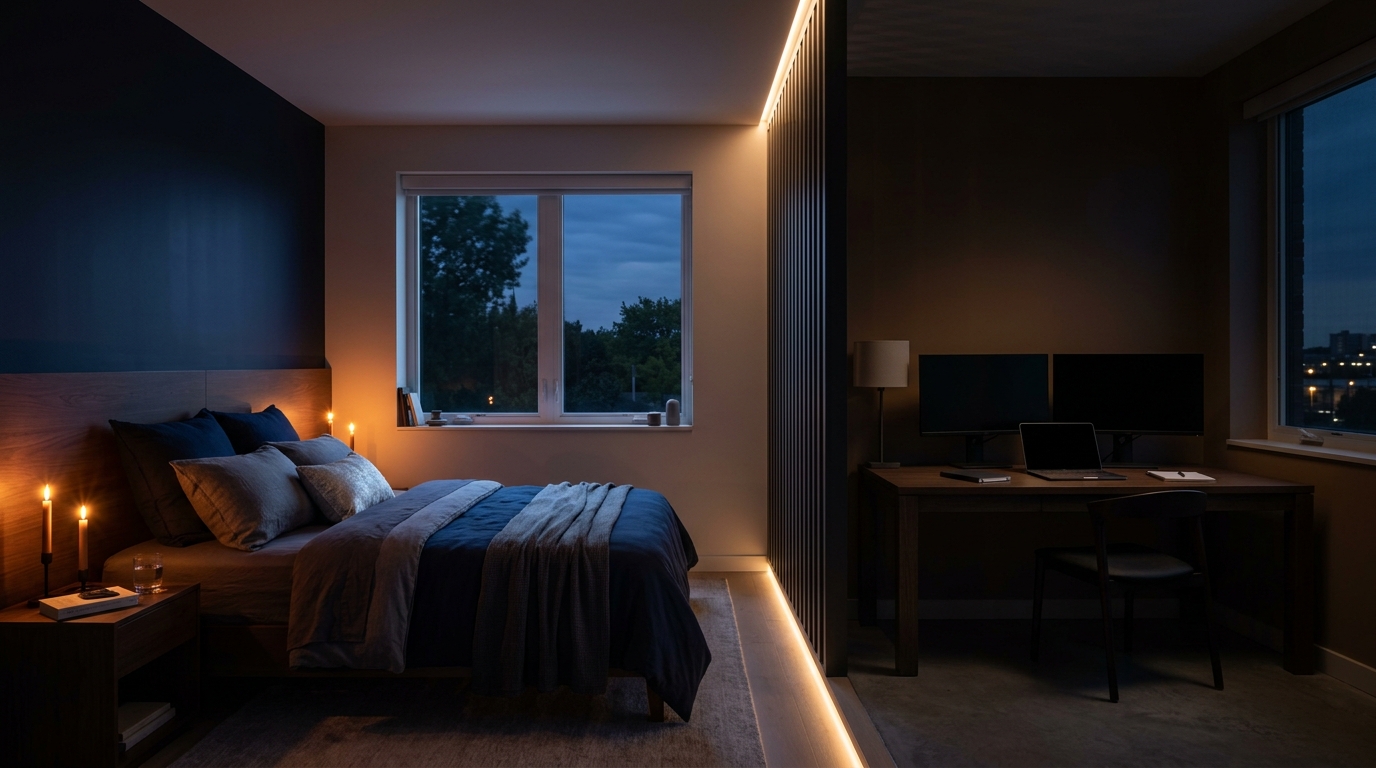
You do not need a separate home office to protect stimulus control; you only need unmistakable sensory cues separating work mode from sleep mode. Changing posture, lighting temperature, and visual sightlines trains your nervous system to recognize when the workday ends—even when your desk sits four feet from your pillow.
"Don't work in the bedroom" sounds easy until your entire apartment is one room. If you live in a studio or shared dorm, physical separation comes from micro-zoning rather than extra square footage:
- Never cross the mattress perimeter with a laptop: Even a tiny folding table, kitchen counter, or upright desk chair placed against the wall creates a distinct postural anchor. Sit upright with both feet flat on the floor for work; reserve horizontal posture strictly for sleep.
- Swap lighting color between modes: Run crisp, bright overhead or desk lighting during work hours. At 7:30 PM, turn off overheads completely and switch to low, warm 2700K bedside lamps. Your retina's melanopsin receptors read that shift as sunset.
- Use a physical "mode reset" prop: Put a structured bedspread or throw over your duvet every morning before starting work, and fold your laptop, charger, and notebook into a closed tote bag or drawer at 6:00 PM. Out of sight means out of conditioned trigger range.
- Follow the 20-minute CBT-I exit rule: If you lie awake tossing for more than twenty minutes at night, step out of bed into your chair under dim light, read three pages of paper fiction, and return only when genuinely sleepy. Never reach for glass while waiting.
Digital Zoning With Morning and Evening FocusWell Schedules
Physical cues work twice as fast when paired with automated digital walls at both edges of the night. FocusWell Schedules let you lock distracting feeds and work apps before bedtime and keep them shielded through your first thirty waking minutes, removing both late-night and early-morning bed scrolling.
Willpower collapses fastest when you are horizontal, warm, and half-asleep. Rather than trusting tired midnight judgment or groggy 7:00 AM impulses, split your day cleanly using two automated FocusWell Schedules built on Apple's native Screen Time API:
- The Evening "Bed Sanctuary" Schedule (10:00 PM – 11:59 PM / Overnight): Block social feeds, short-form video, news, Slack, and work email automatically thirty minutes before lights out. Keep Phone, Alarms, Kindle/audiobooks, and calming white noise unobstructed. Pair the block with FocusWell's Breathe With Us Friction Gate so any impulse tap meets eight quiet seconds of guided breathing rather than an autoplay video.
- The Morning "Feet on the Floor" Guard (6:00 AM – 8:00 AM): This is the secret weapon most people skip. Keep social media, news, and work apps shielded during your first thirty to sixty waking minutes. Because you cannot comfortably scroll in bed, you naturally sit up, drink water, get sunlight, and transition to your actual desk before work begins.
| Daily Habit Zone | Work-From-Bed Trap | Physical + FocusWell Zoned Routine |
|---|---|---|
| First 20 Min Awake | Checking Slack/Reels horizontal under covers | Morning Schedule active; upright posture, water, daylight |
| Daytime Focus | Laptop balanced on knees; stiff neck, low energy | Upright chair/desk; Fast Focus 90-minute sprint |
| Evening Transition | Laptop stays open on duvet until 11 PM | Laptop stowed at 6 PM; warm lamps on, work apps locked |
| Lights-Out Cue | Scrolling until eyes burn; light fragmented sleep | Bed = sleep only; rapid sleep onset and deeper REM |
Curious how many hours of deep sleep and productive mornings bed-scrolling silently steals each month? Run your daily numbers through our screen time life calculator or read how to turn any bedroom into a zero-distraction sleep sanctuary.
The 7-Day Stimulus Control Reset Protocol
Rebuilding a clean bed–sleep neural link takes roughly seven consistent nights of keeping waking screens off the mattress. By combining a morning feet-first rule, an out-of-reach charging cable, and automated FocusWell blocks, most people notice faster sleep onset and deeper morning alertness within the very first week.
Treat the next seven days as a strict clinical experiment—not permanent deprivation:
- Move your phone charger three steps away from the pillow: Plug your iPhone across the room on a dresser or bookshelf so silencing your alarm requires standing upright.
- Ban laptops and work calls from the mattress for seven straight days: No exceptions for "just five minutes" of morning triage. Take every call upright in a chair, even if that chair sits beside the bed.
- Activate both FocusWell Schedules tonight: Lock evening scroll apps at 10:00 PM and keep work/social apps shielded until at least thirty minutes after your target wake time.
- Notice the afternoon energy shift by Day 5: Track your morning energy and weekly stolen-sleep trend inside FocusWell's Weekly Truth Report. Once your brain re-learns that climbing under the sheets predicts instant safety and darkness, falling asleep stops feeling like a nightly negotiation.
Your bed should be the one place on earth where nothing asks for your attention. Download FocusWell on the App Store, activate your Evening and Morning Schedules in under two minutes, and give your brain back the boundary it needs to rest deeply.
Ready to break the compulsive scroll cycle?
Restore your bed as a sleep sanctuary. Download FocusWell and set morning and evening Schedules.
Free 3-Day Trial•100% On-Device & Private•Native Apple Screen Time

Founder & Maker of FocusWell
Founder of FocusWell. Designing behavioral iOS systems that defend restorative sleep and sharp deep work.