The Neuroscience of the 8-Second Pause: Why Mindful Friction Destroys Doomscrolling
Between impulse and unlock, less than 600ms elapse. Discover how an 8-second mindful friction window engages urge surfing to break compulsive dopamine habit loops.
Have you ever opened your phone to check the weather, only to look up 45 minutes later drowning in short-form video feeds, with no memory of how you got there?
You did not consciously decide to abandon your afternoon priorities. What happened was an involuntary neurological hijack.
Between the moment your brain experiences a micro-pang of boredom and the moment your thumb taps the glass, less than 600 milliseconds elapse. In that fraction of a second, your conscious decision-making machinery never even woke up.
To cure doomscrolling, you do not need more willpower. You need to insert an 8-second mindful pause.
Why Willpower Fails Against Algorithmic Dopamine
Willpower fails because it relies on the prefrontal cortex, which is easily exhausted by daily decision fatigue. Compulsive phone habits bypass the conscious mind entirely, executing as automatic motor routines stored in the basal ganglia.
Every major social platform employs teams of behavioral engineers whose primary job is to optimize variable ratio reinforcement schedules — the same psychological mechanism that powers slot machines.
When an action (swiping downward) yields an unpredictable reward (a viral video or an alert), the brain releases a surge of dopamine. Crucially, dopamine is not the molecule of pleasure; it is the molecule of anticipation and craving.
Because you perform this loop dozens of times every day, the neurological pathway undergoes long-term potentiation. The physical movement of unlocking your iPhone and opening TikTok shifts from your thoughtful prefrontal cortex into your basal ganglia — the primitive center of automated muscle memory.
By 3:00 PM on a stressful workday, your willpower battery is depleted. Relying on sheer discipline to resist automated motor reflexes is a biological mismatch.
The 8-Second Rule: De-escalating the Dopamine Surge
An 8-second friction delay disrupts the autonomic dopamine loop by engaging the parasympathetic nervous system and allowing the physiological craving wave to crest and dissolve before the action occurs.
In the 1980s, addiction psychologist Dr. Alan Marlatt pioneered a groundbreaking clinical technique known as Urge Surfing:
A craving is not an irresistible command; it is a wave in the ocean. If you do not fight the wave or feed it, it peaks within seconds and subsides naturally.
The physical reach for your smartphone is an impulse that peaks within 3 to 5 seconds. If an app blocker simply locks you out permanently, your brain experiences emotional resistance. But if you introduce intentional, temporary friction, the dopamine spike decays before you enter the app.
An 8-second window is the neurological sweet spot:
- Seconds 1–3: Autopilot is interrupted. The brain recognizes that the expected instant gratification did not occur.
- Seconds 4–6: The prefrontal cortex comes back online, evaluating the true cost of the action.
- Seconds 7–8: The impulse subsides, returning agency and conscious choice to the user.
FocusWell's 6 Mindful Friction Gates
FocusWell implements multi-sensory cognitive barriers that replace unconscious reflexes with mindful engagement, including breathing prompts, mental calculations, and reflective intent checks.
Unlike primitive apps that display a generic countdown timer, FocusWell rotates through 6 distinct cognitive friction gates to prevent sensory habituation:
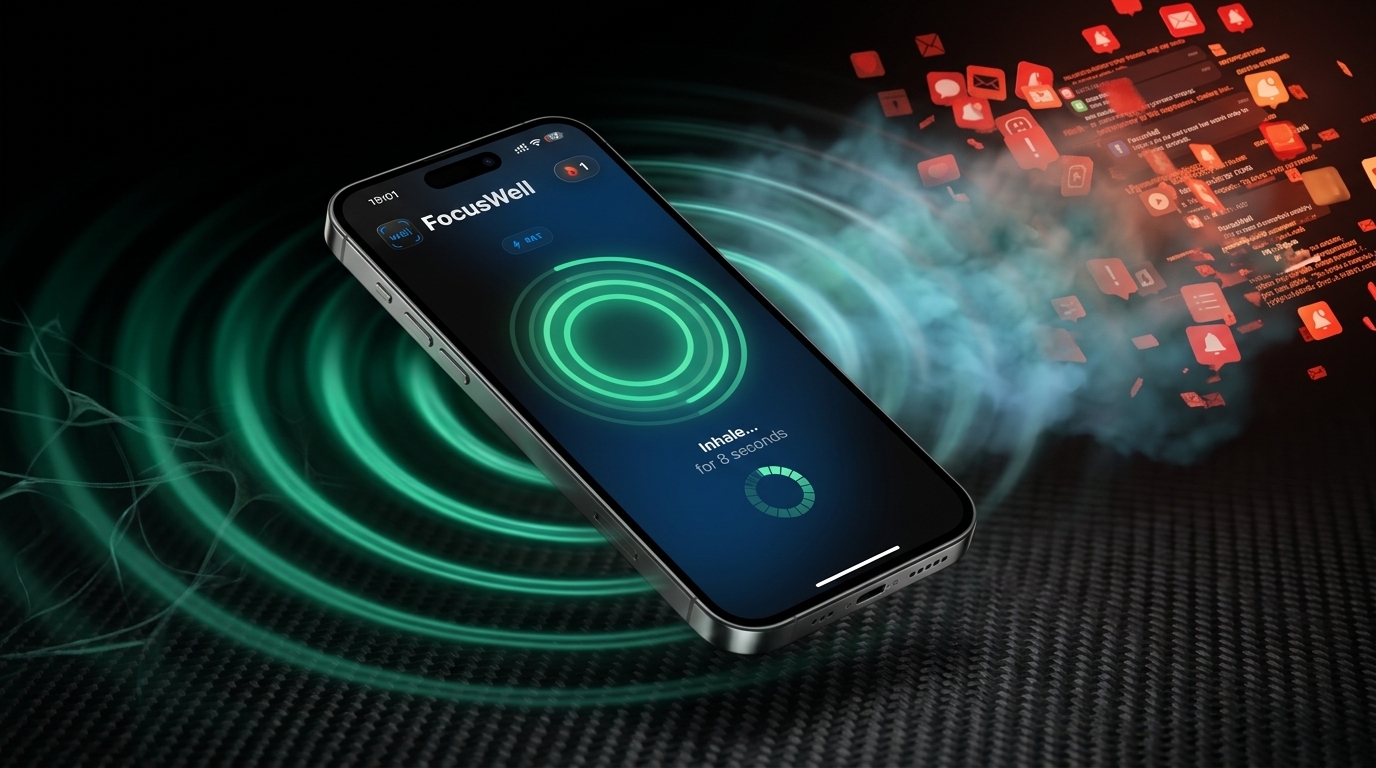
- Breathe With Us: An 8-second guided breathing circle ("In for three. Out for four.") that activates the vagus nerve and lowers resting heart rate.
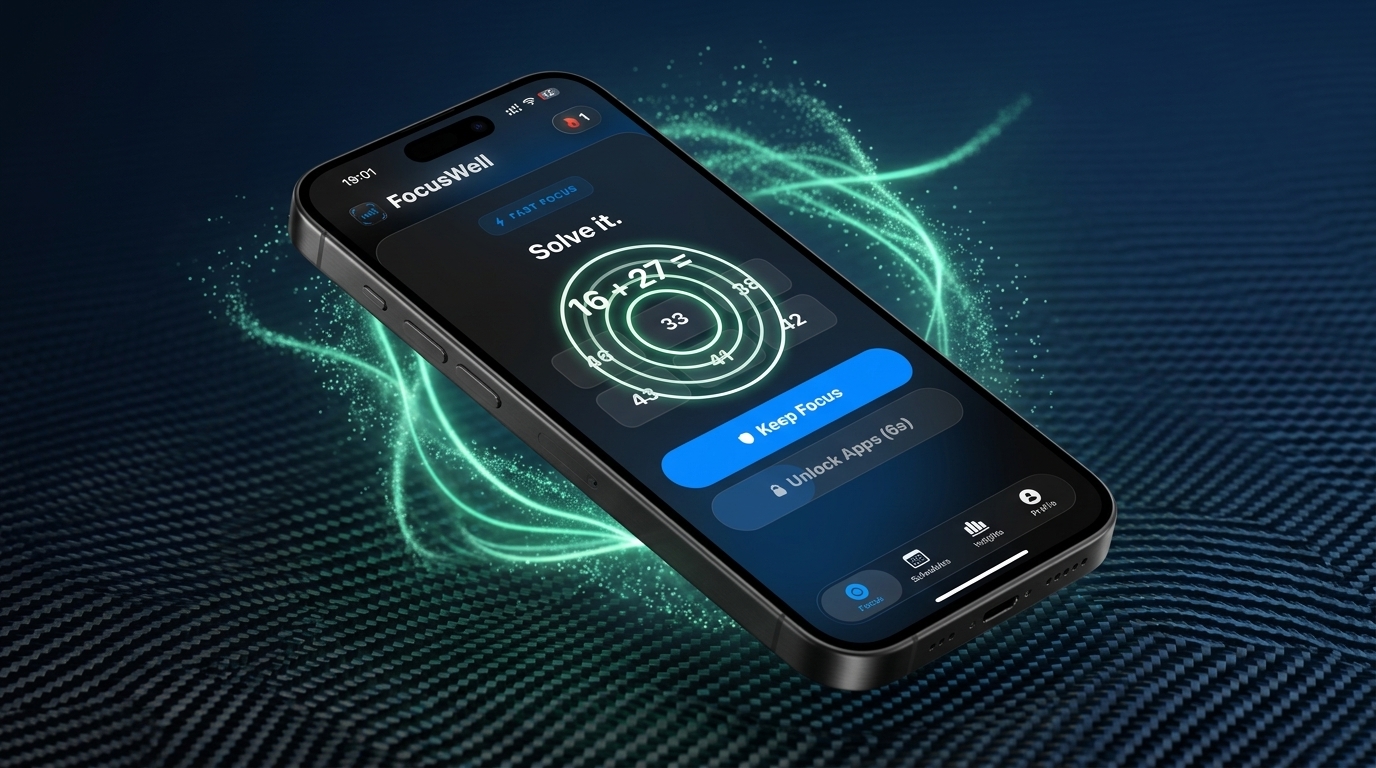
- One Math Move: A 3-slot mental arithmetic challenge (
16 + 27 = ?) that forces the prefrontal cortex to process numerical logic, instantly snapping you out of emotional impulse. - Intent Check: Four rapid questions prompting you to name what specific outcome you came to achieve.
- Nothing Happens: 8 seconds of pure, unbroken digital silence ("Nothing here. That is the point.").
- The Number Climbs: A visual tally showing your accumulated daily opens and minutes spent.
- One Word: A deliberate input gate requiring you to type an intentional grounding word.
Data from FocusWell users reveals that over 62% of impulse opens are voluntarily abandoned during this 8-second window. The user simply locks the device and returns to their life.
How to Deploy Friction in Your Daily Routine
To implement mindful friction effectively, start with your top two trigger applications and pair the pause with intentional replacement behaviors.
- Target Your High-Twitch Apps: Select the 2 applications that account for your highest pickup counts (typically Instagram, X, or Reddit).
- Set FocusWell Friction Gates: Enable the "Breathe With Us" and "One Math Move" gates in FocusWell before access is granted.
- Practice the Pause: When the gate appears, don't tap frantically. Take a full diaphragmatic breath and ask: "What am I actually avoiding right now?"
- Celebrate the Abort: Every time you let the timer expire and lock your phone without opening the app, you physically weaken the automated habit loop.
Consistency is key to digital wellness. By placing 8 seconds of mindful space between the impulse and the action, you reclaim control over your attention.
Ready to break the compulsive scroll cycle?
Break compulsive dopamine loops. Download FocusWell and test mindful friction gates on your iPhone.
Free 3-Day Trial•100% On-Device & Private•Native Apple Screen Time
FocusWell Science Desk
Investigating the intersection of neurobiology, behavioral economics, and digital wellness interface design.