ADHD Paralysis & The Phone Scrolling Freeze Loop: How to Break Free
Stuck on the couch scrolling while urgent tasks wait? Understand the neuroscience of ADHD freeze mode and break paralysis with 5-minute micro-starts.

You are lying sideways on the couch. Your laptop is sitting three feet away on the coffee table. Inside your head, a loud, urgent voice is listing everything you need to start: reply to that client email, open the tax folder, fold the laundry, begin the slide deck.
Your body does not move.
Instead, your thumb keeps flicking upward through short videos, news threads, or comment sections you do not even find interesting. You are not relaxing. Your shoulders are tense, your jaw is clenched, and every ten minutes a wave of dread washes through your stomach—yet you still cannot put the phone down.
If you have ever felt trapped inside your own body while scrolling away an afternoon you desperately needed, you are not lazy. You are caught in the ADHD paralysis freeze loop.
What "Waiting Mode" and Task Initiation Paralysis Feel Like
Task initiation paralysis is an executive function bottleneck where your brain recognizes a task's urgency yet cannot assemble the first motor step to begin. Combined with "waiting mode" before an upcoming call or appointment, it locks you on the couch cycling between guilt and passive scrolling.
From the outside, paralysis looks identical to procrastination or apathy. On the inside, it feels like pressing the gas pedal and the brake to the floor at the exact same moment.
Two distinct patterns feed this state:
- Task Initiation Paralysis: A project feels amorphous, emotionally loaded, or multi-step ("clean the kitchen" or "write the quarterly report"). Because your working memory cannot instantly map a painless starting action, your brain stalls at the threshold.
- "Waiting Mode": You have a dentist appointment or Zoom meeting at 2:30 PM. Even though it is 11:45 AM, your brain flags the afternoon as "compromised." Unsure whether you can safely enter deep focus without missing the time boundary, you hover in limbo—scrolling just to pass the suspense.
In both states, you are not enjoying your screen. You are trapped in holding pattern inertia.
The Neuroscience of the Freeze Response and High-Stimulation Numbing
During ADHD paralysis, perceived task overwhelm triggers a subtle threat response in the amygdala while low tonic dopamine starves the motor initiation pathway. Infinite scroll hijacks this gap by offering effortless, predictable micro-stimulation that temporarily numbs the internal panic without solving it.
Understanding the wiring behind couch lock removes the self-blame that keeps you stuck:
- Amygdala Overwhelm Meets Executive Bottleneck: When a task carries ambiguity, fear of imperfection, or boredom, the limbic system tags it as aversive. Initiating action requires strong top-down prefrontal signaling—precisely the circuit underpowered in ADHD fatigue.
- Dorsal Freeze Instead of Fight-or-Flight: Rather than springing into action, an overtaxed nervous system drops into low-energy immobilization. You physically feel heavy, glued to the mattress or sofa.
- High-Stimulation Self-Medication: Algorithmic feeds require zero executive planning to operate. Every 15-second clip delivers a fast hit of sensory novelty, muting the sharp discomfort of sitting with unstarted work.
- The Post-Binge Crash: After 90 minutes of numbing, your eyes ache and your dopamine baseline dips even lower—which we cover in detail in how to recover from a 4-hour screen binge. Now starting feels twice as impossible as it did at noon.
Scrolling does not cause the freeze—it acts as anesthesia inside the freeze, turning a five-minute hesitation into a lost afternoon.
Why Big Productivity Plans Make the Freeze Worse
Ambitious recovery routines—like promising yourself a sudden two-hour deep work marathon—intensify paralysis because they raise the perceived cost of starting. An overwhelmed nervous system interprets giant, open-ended commitments as further psychological threat, driving your exhausted mind right back toward effortless scrolling.
When people finally snap out of couch lock for three seconds, they almost always overcorrect.
You tell yourself, "Okay, I wasted the morning. From 1:00 PM to 4:00 PM I am going to power through everything with zero breaks."
To a frozen prefrontal cortex, a 3-hour commitment sounds exhausting before you even stand up. So the brake slams harder, and your thumb drifts back to the feed for "just two more minutes."
| Recovery Approach | Nervous System Signal | Initiation Friction | Typical Outcome After 15 Minutes |
|---|---|---|---|
| "I'll lock everything for 3 hours" | High threat & overwhelm | Massive ("all-or-nothing") | Stay on couch; negotiate for "5 more minutes" |
| Pure Willpower ("Just stand up!") | Shame & self-criticism | High emotional resistance | Brief guilt spiral followed by deeper numbing |
| 5-Minute Micro-Start + One Math Move | Low threat, concrete finite window | Near zero ("anyone can do 5 minutes") | Momentum builds; transition into real work |
Breaking a freeze state is physics: static friction is always higher than kinetic friction. You do not need a three-hour blueprint. You need a tiny, low-threat micro-start.
The Micro-Start Protocol: 5-Minute Fast Focus + One Math Move
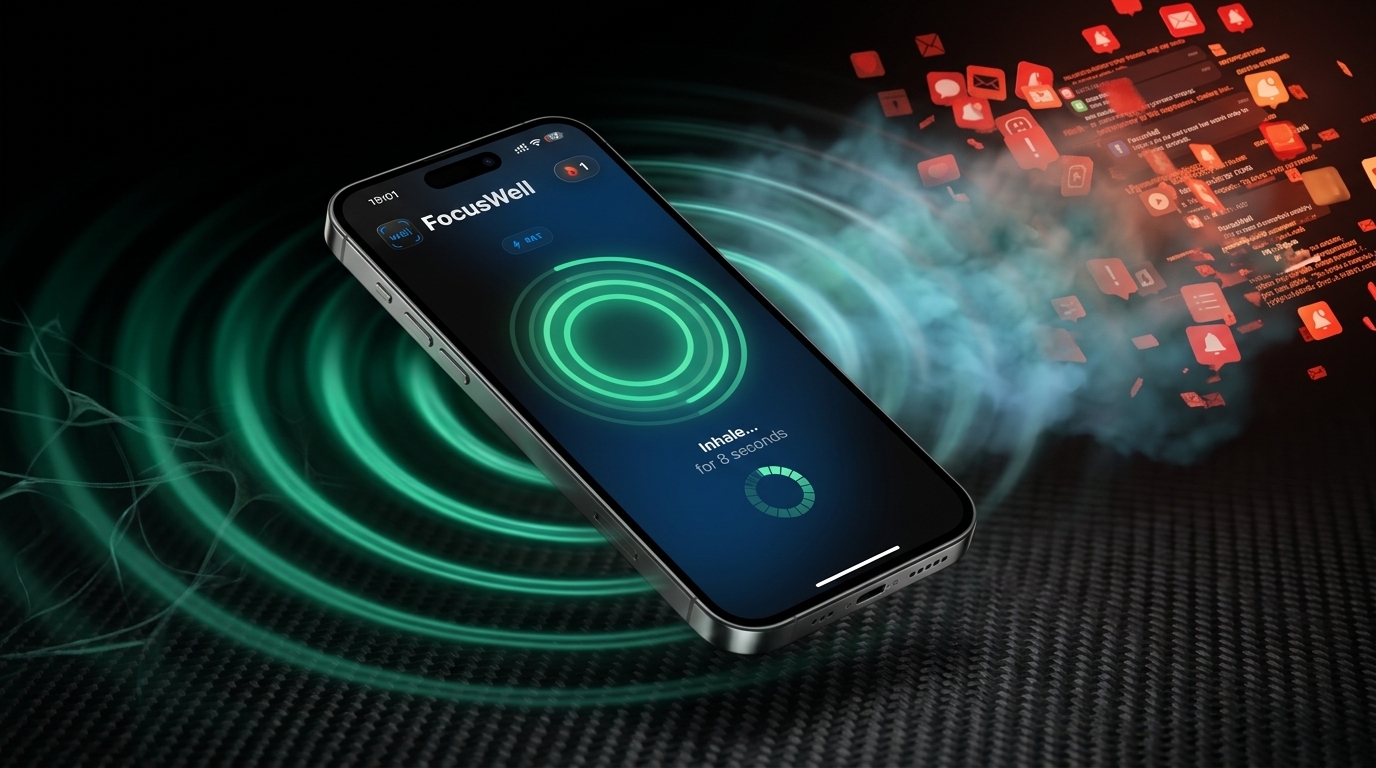
To break scrolling paralysis, combine a 5-minute Fast Focus block in FocusWell with the One Math Move friction gate. The arithmetic prompt disrupts emotional autopilot in seconds, while a tiny five-minute timer lowers the psychological barrier enough for your body to start moving.
Here is the exact four-step sequence designed for moments when you are physically stuck on the couch:
- Engage the Cognitive Circuit Breaker (
One Math Move): When FocusWell's Friction Gates guard your high-scroll apps, every attempted re-open presents One Math Move—a quick 3-slot mental arithmetic prompt. Shifting from passive visual scrolling to active numerical processing forces blood flow back to your dorsolateral prefrontal cortex and interrupts the trance. - Start the Smallest Possible Timer (5 Minutes): Open FocusWell and launch a 5-minute Fast Focus block—the shortest duration FocusWell supports. Tell yourself honestly: "When these 300 seconds expire, I am allowed to stop."
- Use the Dynamic Island as Your Waiting-Mode Anchor: If waiting mode triggered the freeze before an afternoon meeting, let FocusWell's Live Activity count down a clean 15- or 20-minute block on your Lock Screen. Seeing time clearly eliminates the anxiety of losing track of your next call.
- Pick One Ridiculously Small Physical Step: Do not "finish the presentation." Open the file and type one ugly heading. Walk to the kitchen and rinse three mugs.
"You don't need a three-hour burst of willpower to break couch lock. Launch a 5-minute Fast Focus sprint, let FocusWell shield the feed, and just get past static friction."
Nine times out of ten, once five minutes pass, kinetic momentum takes over and you extend the session voluntarily. And on the tenth day when you genuinely stop at minute five, you still broke the freeze without shame.
Rebuilding Momentum After You Break the Couch Lock
Once the first five-minute sprint finishes, protect your fragile momentum by keeping high-dopamine feeds shielded for another 20 minutes of light motion. Transition gently into a sustainable work rhythm rather than immediately rewarding yourself with a risky, open-ended social scroll.
The most common relapse happens at minute six: you complete five minutes of work, feel proud, pick up your phone to celebrate, and fall right back into the exact same scrolling loop.
Keep your gains intact with three quiet guardrails:
- Chain into a 20-Minute Block: If your engine feels warm after the 5-minute micro-start, tap straight into a 20-minute Flexible Fast Focus block while keeping your phone face-up beside you for Lock Screen time awareness.
- Reward with Movement, Not Feeds: When you finish a block, stand up, drink cold water, or step near a window for 60 seconds instead of unlocking Instagram.
- Drop the Moral Scorekeeping: Your Weekly Truth Report and Streaks track consistency over weeks, not perfection on every single Tuesday afternoon.
Paralysis is not permanent, and you do not have to wait for sudden motivation to rescue you. Shrink the first step to five minutes, put gentle native friction between your thumb and the feed, and let small motion melt the freeze.
Ready to keep a five-minute micro-start button in your pocket? Download FocusWell on the App Store (getfocuswell.com) and turn your next freeze loop into calm forward momentum.
Ready to break the compulsive scroll cycle?
Break couch lock in five minutes. Download FocusWell and launch a 5-minute Fast Focus micro-start.
Free 3-Day Trial•100% On-Device & Private•Native Apple Screen Time

Founder & Maker of FocusWell
Founder of FocusWell. Exploring the intersection of executive dysfunction, nervous system regulation, and gentle iOS friction.