Digital Satiety: How to Tell When Your Brain is 'Full' and Needs Integration
Learn to recognize the neurobiological signals of digital satiety, stop information binge-eating, and allow your brain to synthesize deep insights.
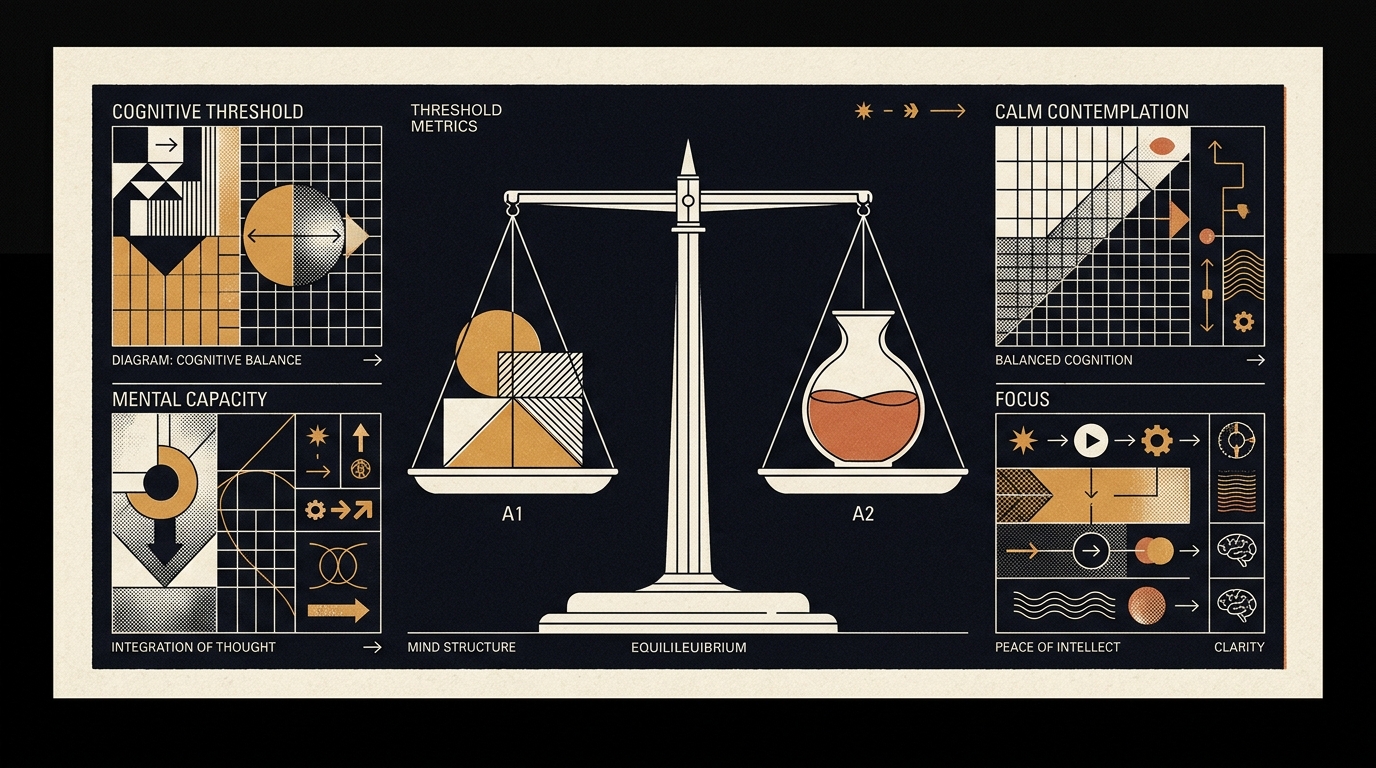
If you eat four slices of pizza, your stomach sends hormonal signals (leptin) to your hypothalamus indicating physical fullness. You experience satiety—a clear, unambiguous biological sensation that whispers: “Stop eating.”
Now consider your digital life.
You have been scrolling investigative essays, listening to a 3-hour podcast, checking financial tickers, and browsing short-form videos for four continuous hours. Your eyes burn, your neck is stiff, and you feel mentally numb.
Yet you continue scrolling.
Why? Because human evolutionary biology evolved in an environment of extreme information scarcity. Our ancestors needed to devour every scrap of environmental data to survive. We have evolutionary leptin for calories, but zero innate hormones for digital content.
Understanding the concept of Digital Satiety is the only way to escape chronic information obesity.
The Cognitive Metabolism: Digest or Choke
Cognitive metabolism refers to the biological process by which the brain absorbs sensory data, processes it through the prefrontal cortex, and consolidates it into durable neural frameworks. When input velocity exceeds processing capacity, the brain experiences cognitive indigestion.
Just like biological digestion, your brain possesses distinct stages of information processing:
- Ingestion (Input): Reading text, hearing audio, or watching visual streams.
- Digestion (Working Memory): Comparing new inputs against existing beliefs and questioning assumptions.
- Assimilation (Synaptic Consolidation): Integrating valuable concepts into long-term memory schemas during periods of rest.
- Elimination (Discarding): Letting go of irrelevant noise and trivia.
When you engage in continuous, non-stop digital consumption, you skip stages 2, 3, and 4 entirely. You enter a state of chronic cognitive indigestion.
`
Healthy Cycle: [Input: 30 min] ──> [Digestion & Synthesis: 15 min] ──> [Consolidation: Rest] ──> [Mastery]
Digital Gluttony: [Input] ──> [More Input] ──> [Novelty Spike] ──> [Cognitive Indigestion] ──> [Brain Fry]
`
The 4 Warning Signs That Your Brain is "Full"
Because your phone will never tell you to stop, you must train yourself to identify the subtle somatic warning signals of digital fullness:
1. The Glazed "Zombie Scroll"
You are no longer actively reading sentences; your eyes are simply tracking moving pixels down the glass. If you ask yourself “What did I just read sixty seconds ago?” and cannot answer, your working memory has shut down.
2. Decision Paralysis on Trivial Choices
When your prefrontal cortex is exhausted from processing thousands of algorithmic micro-inputs, basic choices (what to eat for dinner, which email to answer first) feel overwhelmingly difficult.
3. Irritable Agitation
You feel a sudden spike in baseline irritability when someone in the physical room asks you a simple question. Your overloaded nervous system perceives any additional sensory demand as an assault.
4. "Screen Apnea" and Frontal Tension
A tight, dull pressure behind your eyes or across your forehead, accompanied by shallow, infrequent breathing while looking at screens.
3 Strategies to Enforce Digital Satiety
To protect your cognitive health, you must install external, environmental boundaries that honor your biological limits.
1. The "1-to-1" Input-to-Integration Ratio
For every hour of dense audio or text consumption, mandate thirty to sixty minutes of zero-input integration. Go for a walk without headphones, take a shower, or write down raw reflections in an analog notebook. Give the ideas time to digest.
2. Put Down the Fork: Stop Seeking One More Take
When researching a topic or following an event, set a predetermined boundary: “I will read two high-signal analytical articles, and then I am done.” Resist the compulsive urge to consume eighty opinions on the same event. More opinions do not yield more truth; they yield confusion.
3. Hard Stop-Limits with FocusWell
When habit loops push you past natural satiety, FocusWell’s Open Limits act as an external satiety switch. By capping how many times you can launch information feeds each day, FocusWell guarantees that you step away from the buffet before cognitive exhaustion sets in.
Feast on Wisdom, Starve the Noise
A full mind that has digested deep ideas is articulate, calm, and visionary. An overstuffed mind drowned in algorithmic trivia is anxious, reactive, and forgetful.
Learn to recognize when you are full. Push away from the screen, close your eyes, and let your mind digest.
Ready to break the compulsive scroll cycle?
Know when your mind is full. Download FocusWell and enforce daily caps on compulsive digital inputs.
Free 3-Day Trial•100% On-Device & Private•Native Apple Screen Time

Founder & Maker of FocusWell
Founder of FocusWell. Exploring cognitive metabolism, information architecture, and mindful technology.